Showing posts with label religion. Show all posts

Wednesday, November 17, 2010

Coptic Cairo

After a lovely four-course luncheon and stimulating table conversation with my Lawrence professors, Mom and I headed by taxi to the Christian area of Cairo. Unfortunately, our taxi driver dropped us off at a major intersection without any indication of the direction of the Coptic city, so we walked randomly and found ourselves at a very large mosque where we witnessed a baby without pants pooping on the grass, fully veiled women glaring at us from their eyeholes, and from which we were ultimately shooed away by large policemen with guns.
Realizing our mistake, that we had actually walked in the opposite direction of the walled/heavily secured Christian area, we traipsed back to our starting point and found the correct entrance.
Coptic Cairo appeared, as my Mom observed it, like a Disneyworld attraction. The streets were fairly clean for Cairo and besides the Coptic locals, most of the people milling about where Japanese and American tourists. The buildings were all whitewashed and medieval looking, and the rest of the town was comprised of either medieval church buildings or souvenir shops, just like Epcot.
We wound our way through the narrow alleyways, peeking into small chapels, reliqueries, and churches. The last stop on this short visit was the Hanging Church, which looked like something out of Mexico with a cactus in front of it (see picture below). It's called the "Hanging Church" because it is suspended over an old Roman fort.


The architecture inside was not very impressive, though the churches' importance lies in its role as the seat of the Coptic patriarchate. We even witnessed a priest with a chest-length beard and kind smile blessing children. The experience was an interesting one for its human factor- from the old Christian women kissing the relics of saints, to the nuns walking about, and the intermingling of Christians and Muslims, co-habiting, at least in this moment in space and time.

Sunday, October 10, 2010

My camera isn't waterproof, and other lamentations

On the day that I chose to take a walking tour of old Istanbul, the weather turned to a bleak 50 degrees with a side of pouring rain. It did not help that all of my jackets are back in the United States, safely packed away in boxes awaiting my return. (I mean, who needs a jacket in perpetually 90 degree Cairo?) So, I bundled up, layering all of the shirts that I brought with three pairs of tights under a summer dress.
Luckily for me, I got to see amazing things, in the culmination of the best of Istanbul: my grand finale.
Our first stop was the Blue mosque, a staple of every trip to Istanbul. Unfortunately, a cruise ship docked a few hours earlier on the Bosphorous, and I ended up having to wait in an hour long line, drowning in a sea of French people who were trying to elbow their way in front of me. The Blue mosque was kind of a let-down at this point, because it looked like almost every mosque that I had been to in Turkey and Egypt. The worst part was that the place has only one exit, so I had to stand in another line (with French people) to get out of the building, all the while thinking about how much of a fire safety code hazard it was. (I'm sure that was not on the priority list of architects in the 1500's).
The Blue Mosque

The next stop was Topkapi palace, the abode of the early sultans. Again, the place was mobbed, but I got to see the most beautiful Ottoman architecture- white washed walls guilded with gold- as well as the sultans' jewelery (including the fifth largest diamond in the world), spoils of war, presents from other empires, swords, thrones, bejeweled clothing, and the Prophet Mohammed's paraphernalia (hat, sword, tunic) as a demonstration of Ottoman control over Mecca and Medina.

After a short lunch break, my group sojourned to the place that was the reason for my pilgrimage to Istanbul: Hagia Sophia, or in Greek, Holy Wisdom. This church was built in the 500's by Emperor Justinian and Empress Theodora of the Byzantine empire, and was the largest building in the world for a millenium. When the Ottomans conquered, they turned the church into a mosque, which is reflected in large disks on four corners of the dome that bear the names of God, Mohammed, Ali, and Abu Bakr.

My favorite part of the museum was the Byzantine mosaics. Somehow, the French people had not yet weasled their way up to the upper floors of the museum, and I was able to stand contemplatively in front of a shimmery golden mosaic of Jesus for a peaceful and undisturbed five minutes. Then a slew of French people emerged, knocking me away from Jesus, and prompting me to hoof my way toward the exit.
Jesus, for those of you who are not in the loop.

The next destination was an underground water passage called the Cistern. It served as a resting point for water on its way through aqueducts to the surrounding region. The cavernous cistern was a bit spooky, because its Roman columns and pools of water were lit blood red by theatrical lights. However, the place exuded an appealing atmosphere of ancient mystery.
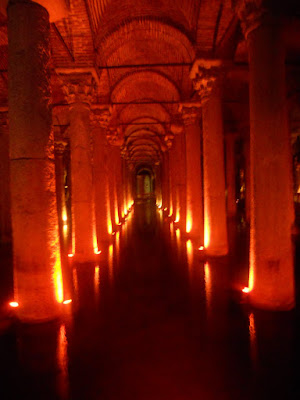
At the end of our tour, we were dropped off at the Grand Bazaar, which I believe was a practical joke played on us by our impish tour guide who, at the Topkaki palace security check point, made the announcement that if we had any bombs on our person, we should leave them at the gate.
The bazaar was a labyrinth, and only someone with a sense of humor could escape unterrified from the chaos within. According to Arman, our guide, the bazaar has 4,000 stores and 60 exits. Luckily, I made a friend from the tour, an older man on vacation (for his bucket list), and we navigated the place together. He wanted to find his daughter some jewelery, but I just wanted to go home. I won.
After a day of trudging through the cold and pouring rain, I was soaked to the bone, and just wanted a good meal. I decided to return to the restaurant where I dined on the first night, this time indulging myself with Baigan Bharta, my favorite Indian dish. It did not disappoint.
I can thank the universe for the crappy weather at the end of my trip, because it made going back to Cairo a bit easier. Traveling always seems to be a hassle, though, and I did not evade trouble on my way out of Turkey. At the airport, I couldn't walk through to the passport check booth because it was blocked by a wall of hundreds of people and their suitcases on their way to Medina (plus their family members who were 'well-wishing' them off on their journey). When I finally pushed my way through, I made it to the other side where I was greeted by a "dondurma" stand. A friend of mine had recommended dondurma, a special Turkish stretchy/non-melting ice cream that is not technically legal outside of Turkey. I saw this as my last chance for the near future, so I stopped and paid the dondurma guy three American dollars to have my first bite, and it was so worth it!

My dreamlike trip to Turkey ended as soon as I stepped out of the Cairo airport into the hot, glaring sun, with taxi drivers ready to pounce on me, trying to overcharge me for a ride home. Hah! If they thought I was going to pay 100 LE for a taxi ride, they were sorely mistaken. A more perceptive taxi driver caught on that I was not a mere American tourist, and offered me a more reasonable fare, 70 LE for the trip. I was so proud of myself when I was able to instruct him, in Arabic, how to get back to my apartment (from the highway).
After successfully completing an infinitely amazing trip that I planned and executed myself, I crashlanded on my bed and called it a day.

Thursday, October 07, 2010

A Blustery Day on the Bosphorous


I woke up to the faint sound of a light rain pattering on my window. Usually I would be disappointed by this type of weather, but its exoticism appealed to me. I don't even remember the last time I felt rain on my skin or temperatures lower than seventy degrees.
After a filling breakfast, I decided to enjoy this cool October day by walking back to the bustling part of the city to change money. The rain had stopped, and a quiet sunlight edged through the thick clouds. There was a damp wind gusting in from the sea, and I thought I was in heaven.
Then it started to rain again: it was a torrential downpour of epic proportions. I took refuge in a mall, but knew I had to get back to my hotel for a tour, so I bought a cheap umbrella and headed back, making it just in time for my tour guide to pick me up.
My excursion today was a guided cruise on the Bosphorous, the channel between the Black and Marmara Seas. It is also the point at which Asia meets Europe. Joining me on the tour was a forty-something American man who lives and works in Saudi Arabia, a British soft butch and her Indian girlfriend, and then our Turkish tour guide. I liked that our group was more cosmopolitan and international than the many large and sheeplike American tour groups that I had seen milling around the city- the suburban men wearing their short pants with socks and sandals (oh the humanity) and their wives who screeched across crowded marketplaces something along the lines of, "Hey Herald, they have goat cheese and sheep skins for sale here!". Face palm.
Even though the weather was not ideal for a cruise, we had a jolly time. The scenery was beautiful, making me want to stay here even longer. Most of the city beyond the center is forested, and many wealthy Turks build cottages and lodges along the Bosphorous. There were also mansions, the sultan's palace, mosques, churches, and a Byzantine fortress that was overtaken by the Ottomans in the 15th century.

The sultan's palace.
The fortress.

The group was so small, and the cruise so long that we were able to hold a decent conversation. The man told us that Saudi Arabia basically sucks, and that as soon as possible he would try and leave. Originally from Houston, he has been living in the Kingdom for two years as an accountant for Aramco and resides in an expat compound in a smaller city of Khafji. When I told him I was studying in Egypt, he remarked (without any prompts) that Cairo was horribly dirty, but that Saudi Arabia is not much better. The worst parts about it, he explained are the lack of natural beauty, dirtiness, and the extreme and unparalleled gender segregation. He remarked that his office building does not even have a womens' bathroom. And I thought Egypt was bad . . .
After the cruise was over, we went to two mosques that were built approximately five hundred years ago. The first one looked exactly like the mosque of Mohammed Ali in Cairo (who was an Ottoman), but the second one was charming and small with special Turkish tiles throughout. I neglected to bring a headscarf, so I had to borrow one. Thankfully, it was clean and pressed, and the loan scarves came in many colors so I got to choose one that best fit my outfit. Some people have asked if I am bothered by veiling, but in reality, I feel that (at least in religious spaces) it is a sign of cultural respect. Veils were mandatory in catholic churches until Vatican II, and most other Abrahamic religions require headcoverings for men and women. The veil has become so politicized (for good reason in many cases where it is forced upon women in some fundamentalist countries), but I feel that a woman should have the choice whether to veil or not. For many women, the choice to veil is empowering.
The first mosque.

The second mosque.
Me.

After the tour I planned to go and see a Sufi music concert and whirling dervish performance in the downtown Sultanahmet area. When I walked there, however, I learned that the show was sold out. I was disappointed, but I had a backup plan. When I visited the bazaar down the street from my hotel, there was a large open air cafe with billboards advertising live music and a dervish performance. I was skeptical about its quality, but decided to go, thinking that at the very least I would have a satisfying meal. When I got there, the place was packed with Turks, and the music had already started. Then the dirvish man appeared. His twirling was hypnotic, and his eyes were half-open in a trance-like gaze. He moved rhythmically to the drumbeats as he alternately raised and lowered his hands, experiencing the intoxication of God.

The music continued for two and half hours, during which I ordered a "pancake" that was really a spinach crepe, some tea, and an apple-flavored water pipe. (Yes, for you Austin Powers fans: I had a smoke and a pancake).
The experience was amazing. I smoked (something that will not become a habit) to stave away the bone-chilling cold, and read a book that I had brought from home. A few older American couples at the cafe were charmed by my smoking hookah and took pictures of me on their cameras (and mine) to tell their friends about the little girl who picked up the waterpipe for the first time just to have the experience.


Did I also mention, that I didn't know how to use it, which tickled the waiters immensely."You haven't smoked before?", they asked amused at my naivete.
When the music ended, and the embers were dying in my pipe, I decided to call it a night, saying a brief goodbye to a cafe that provided me with an unforgettable evening.

Monday, September 20, 2010

The anti-Barbie


Just a warning: this post is random.
Since last week I have been on the hunt for the Muslim Barbie doll named Fulla. *I really want to buy her!* She's going to be my personal souvenir from my trip to Egypt as soon as I can locate a toy shop in my neighborhood.
Let me tell you a little about Fulla, because I find her fascinating on many levels. Fulla was marketed to Muslim countries starting in the 90's as a backlash against Western values, and as a way to promote modest dress and behavior. Some say it was part of a larger movement to get more young women to wear headscarves. Among her warddrobe items is a full length hijab, and shorter veils. Her life also revolves more around the home and family, and she loves to pray.
Besides these obvious differences from Barbie, she is represented in many careers (doctor Fulla, teacher Fulla), and likes shopping, cars, and being with friends. There is no Ken equivalent, because dating is forbidden, but I think she is better off without him anyway.
If I can't find Fulla, I will buy Jamila, another doll that embodies the same values and is Fulla's rival.

When I locate her, I will let all of you know.

Saturday, September 18, 2010

The Citadel


For the most part, I will let the pictures speak for themselves, because they are numerous and self-explanatory. A brief background: yesterday I went to the citadel, a 12th century fortress built on a bluff overlooking Cairo. Centuries of rulers used the citadel as living quarters, building multiple palaces, as well as a religious center with about five mosques, and a military base.
Now for the pictures.


Above is the mosque of Mohammed Ali, a 19th century ruler of Egypt. The mosque was his way of sticking it to his former bosses, the Ottomans. By defying them in building more than three minarets, and (in his mind) replicating the splendor of the Blue Mosque, he showed them that he was not going to be their docile follower. Needless to say, the Ottomans were not happy with this turn of events.
The next few pictures are of a secondary mosque.


The Egyptian military museum at the citadel was interesting to me because of its propagandist agenda. The prime examples being the glorification of Nasser, and the Egyptian government's spin on battles with Israel that didn't end in their victory. Don't misunderstand me, I'm sure there is an equally propagandist museum in Israel (or the United States), which I would be just as amused to see. That's the kind of cynic that I am. On the propaganda scale, the Egyptian military museum rates far below North Korean state television but slightly above a fourth of July parade.